

According to the report by the global financial services major, the FY2013-14 CAD is expected to be within $36 billion or 2 per cent of GDP, and this fiscal year CAD is likely to be slightly higher but contained at 2.3 per cent of GDP.
.jpg)
The Indian currency had hit record low of 57.32 against a dollar in June last year.

To meet the revised estimates for 2019-20, the central government will have to garner Rs 5.03 trillion in total revenues in March, which has seen the worst phase of the coronavirus pandemic so far and the resultant lockdown.

'If Urjit Patel had resigned after the five-state elections results people would have taken a different view. So this was the right time for him to resign.' 'He rightly resigned as he felt the differences with the government were not getting settled.'

India's trade deficit shrank to a 10-month low in December as global oil prices tumbled and demand for gold fell, auguring well for Indian current account balance and the rupee.

Of the eight RBI governors who have held office since the 1991 economic liberalisation, Bimal Jalan had the longest stint and S Venkitaramanan, the shortest. Current Governor Shaktikanta Das will overtake Bimal Jalan before completing his second term in December, points out Tamal Bandyopadhyay.

Corporate India is more dependent than before on exporters of IT services such as Tata Consultancy Services (TCS), Infosys, and Wipro for earning foreign exchange. Such companies account for nearly 43 per cent of the forex revenues of listed firms, up from 22 per cent a decade ago. The listed IT services companies earned nearly Rs 4.2 trillion through exports in FY22, up 15 per cent from the Rs 3.65 trillion a year earlier. In comparison, the forex revenues or exports of the rest of the BSE500 companies were down 11.9 per cent to Rs 5.6 trillion last financial year.

The government had pegged the fiscal deficit for 2020-21 at Rs 7.96 lakh crore or 3.5 per cent of the GDP in the budget presented by Finance Minister Nirmala Sitharaman in February.

The GDP growth for 2013-14 has been lowered to 5.3%, from 6.4% in April.

In the mid-quarter review on December 18, the Reserve Bank left key policy rates unchanged but said it will hike interest rates if inflation does not subside.

'A time-wise, as well as price correction, so that the market can absorb the gains made over the past 17 months.'

NITI Aayog vice chairperson Rajiv Kumar tells Indivjal Dhasmana that additional funds could be generated through divestment, and that the fiscal deficit should be widened while focusing on the revenue deficit.

There has been sizeable rise in external commercial borrowing and and rupee denominated Non-resident Indian deposits.

Thanks to rupee depreciation, India has a chance to fundamentally rework its stifled manufacturing sector.

Short-term lending rate unchanged at 7.75 pc.

The decline in gold imports has helped in narrowing the country's trade deficit to $106.84 billion during the eight-month period under review as against $133.74 billion in the year-ago months.
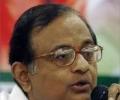
Addressing bankers and economists at Bancon 2013, a flagship event of the Indian Banks' Association, Chidambaram told the lenders to deal firmly with wilful defaulters, but handhold those who are reeling under the impact of the economic slowdown.

Highlights of RBI's third quarter review of monetary policy.
.jpg)
The toxic brew of fiscal populism, crony capitalism and bad economic management has ensured the collapse of economic growth, industrial stagnation, stubbornly high consumer inflation, declining savings and investment, shrinking employment opportunities, and a dangerously vulnerable external financing situation.

India Ratings principal economist Sunil Kumar Sinha said the Brexit is a mixed bag for the country.

Market participants attribute the stability to the Reserve Bank of India's timely intervention in the foreign exchange market, both in terms of selling and buying dollars.
Foreign investors have poured in a whopping Rs 9,600 crore (Rs 96 billion) in the stock market so far this month, mainly on the hopes of a stable government in general elections starting next month.
.jpg)
Traders say the outlook for the rupee has improved on the back of a sharp narrowing in the current account deficit after government and central bank emergency measures such as curbing gold imports.

Kamath said India's economic climate had started improving.
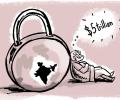
India decisively withstood global headwinds in 2023 and is likely to remain as the world's fastest-growing major economy on the back of growing demand, moderate inflation, stable interest rate regime and robust foreign exchange reserves. Despite widespread pessimism witnessed among the developed nations and the worsening geopolitical situation, India recorded a gross domestic product (GDP) expansion of 6.1 per cent in the March quarter. The growth moved up to 7.8 per cent in the June quarter and was 7.6 per cent in the September quarter. For the first six months of this fiscal, the growth was 7.7 per cent.

Raghuram Rajan will take over as RBI Governor on September 4 at a time when the country is facing a grave economic crisis.

Uptick in growth projected in second half of current fiscal based on 10 factors including higher FDI flows, build up of demand pressure, positive GST revenue growth

It has mostly been a one-way street for markets that have moved up sharply since July. The front-line indices - the S&P BSE Sensex and the Nifty50 - have gained 6.7 per cent and 7.3 per cent, respectively, in the past three months. The rally in mid- and small-caps has been sharper, with both indices surging 14 per cent and 9 per cent, respectively, during this period. This sharp run has made analysts at Jefferies cautious.

The value of oil imports decreased by 37.5%.

To enable widen the fiscal deficit beyond the permissible limit under the present legislation, the government may have to propose amendment to the FRBM Act in the Finance Bill.
.jpg)
Exports picked up to post a growth of nearly 13 per cent.

Union Finance Minister Nirmala Sitharaman, along with her team of bureaucrats, delved into the fine print of the 2024-25 Budget documents in a press conference, detailing the government's road map on bringing down the debt-to-GDP ratio and bold tax measures.

India's current limit of $25 billion for ownership of government bonds by FIIs is fully utilised, leading to calls for increasing it
Reserve Bank Governor Shaktikanta Das on Friday said 67 per cent of the decline in the foreign exchange reserves since April was due to valuation changes arising from strengthening US dollar and higher American bond yields. The forex reserves, which stood at $606.475 billion as on April 2, have declined to $537.5 billion as on September 23. It was also the eighth straight week when the reserves declined.
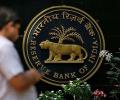
Liquidity in the banking system has slipped into a deficit for the first time in three weeks, prompting banks to borrow the largest quantum of funds from the Reserve Bank of India (RBI) in around a month and a half. The key catalyst for the sudden tightening in liquidity was due to outflows on account of advance tax payments, which occur towards the end of a quarter. Analysts also cited other factors such as a currency leakage and possible interventions by the RBI in the foreign exchange market, which contributed to the tighter liquidity conditions.

Air travellers currently can bring a flat screen television for personal use without paying any duty.

India's foreign exchange reserves surged $5.04 billion in the week ending March 28, its biggest weekly rise in four months, as the central bank started to buy dollars regularly in an effort to build up its defences against any potential global turmoil.
 © 2026 Rediff.com - Advertise with us - Disclaimer - Privacy Policy - Sitemap - Feedback - About us - Terms of use - Grievances